2025-26 Cohort

Erika Anderson
| Postdoctoral Fellow | Cardiovascular Research Institute | Elphege Nora Lab |
Research Topic: Systematic identification and manipulation of factors that mediate long-range enhancer activation
I am a postdoctoral researcher in the lab of Elphege Nora, where I use mouse embryonic stem cells to study how chromosome folding controls transcription. I am investigating how the cohesin complex directs communication between regulatory elements and their target genes, as well as performing screens to identify new factors important for long-range gene regulation. Previously, I received my PhD with Barbara Meyer at UC Berkeley studying how chromosome structure affects X chromosome dosage compensation and aging in C. elegans. Outside of lab, I enjoy performing with Improv at UCSF, playing the carillon bells, and exploring the beautiful parks of the Bay Area.

Mercedes Barrero Asencio
| Postdoctoral Fellow | Department of Urology | Robert Blelloch Lab |
Research Topic: Development of iPSC-derived tolerogenic dendritic cells to study mechanisms of tolerance
My name is Mercedes Barrero and I am a postdoc in the Blelloch lab. My current work involves engineering hiPSCs to generate dendritic cells capable of suppressing T cell responses and dissecting the mechanisms underlying dendritic cell–driven tolerogenesis.
Before joining UCSF, I completed my PhD in the Payer lab at the Centre for Genomic Regulation (Barcelona), where I investigated the mechanisms of X-chromosome reactivation during the reprogramming of somatic cells into iPSCs.
Outside the lab, I enjoy arts and crafts, traveling, hiking, and admiring California sunsets.

Ritusree Biswas
| Postdoctoral Fellow | Department of Medicine | Tien Peng Lab |
Research Topic: Fibroblast orchestration of allergic inflammation and goblet cell metaplasia
I am a postdoctoral researcher in Dr. Tien Peng’s lab, Department of Medicine, Pulmonary Division. I am originally from India and moved to the US for pursuing my postdoc. I carried out my Ph.D. at the Institute for Stem Cell Science and Regenerative Medicine, Bangalore, India. During my Ph.D., I investigated the mechanisms that keep skin stem cells in a quiescent state and the role of mechanotransducer as niche factors that sustain this balance. After completion of my Ph.D. I joined Dr. Tien Peng’s lab to learn more about the stromal cells. Particularly, I study how complex signaling in fibroblast niches controls airway stem cell fate and mucus pathology in the context of allergic asthma.
Outside lab I love travelling to places, trying out new food and go for hiking. I also enjoy swimming and playing badminton.
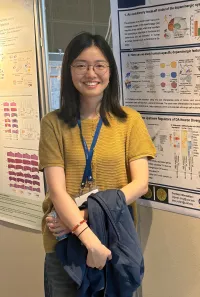
Jingwen Ding
| Graduate Student | Department of Neurology | Alex Pollen Lab |
Research Topic: Gene regulatory networks governing human cortical fate in neurodevelopment and neurological disorders
My name is Jingwen Ding and I am a BMS graduate student in Alex Pollen’s lab. I graduated with a B.S. in Pharmaceutical Sciences from the University of Tokyo where I studied epigenetic regulation of mouse neural development. My current research focuses on understanding mechanisms governing cell fate transitions in human cortical neurogenesis and how they are impacted in neurodevelopmental disorders. Outside of lab, I enjoy exploring new coffee and boba shops, hiking, and swimming.

Can Goskal
| Graduate Student | Cardiovascular Research Institute | Abigail Buchwalter and Basseem Al-Sady Labs |
Research Topic: Investigating the molecular mechanism of lamin B receptor-mediated chromatin tethering to the nuclear periphery during stem cell differentiation
Hi I’m Can, and I’m a TETRAD graduate student in the labs of Dr. Abby Buchwalter and Dr. Bassem Al-Sady. I was born and raised in Turkey but moved to the Bay Area for my undergraduate studies and received my B.A. in Molecular & Cell Biology from UC Berkeley. My current research lies at the intersection between my two labs, where chromatin regulation meets the nuclear lamina. Specifically, I am studying the molecular interactions between a key lamina-associated protein, LBR, and chromatin, to understand how they contribute to a key developmental transition in stem cell development. By leveraging biochemistry and genomics in a mouse embryonic stem cell model, I aim to uncover the biophysical requirements of lamina-mediated chromatin repression in development. Outside of the lab, I enjoy skiing, jamming on the guitar, and playing board games.

Emily Graham
| Graduate Student | Institute for Neurodegenerative Diseases | Carlo Condello Lab |
Research Topic: Investigating CSF1R SNP mutations in Microglial dysfunction and leukoencephalopathy
I am an MD/PhD (MSTP) student at UCSF in the Tetrad Graduate Program, working in the laboratory of Dr. Carlo Condello at the Institute for Neurodegenerative Disease. My research focuses on understanding how mutations in the colony-stimulating factor 1 receptor (CSF1R) disrupt microglial function and contribute to demyelination in adult-onset leukoencephalopathy. I am particularly interested in leveraging stem cell–based therapeutics to develop disease-modifying treatments for neurodegenerative disorders.
I earned my BA in Chemistry from Mount Holyoke College, where I used polymer chemistry approaches to design pH-sensitive nanoparticles for drug delivery. Following graduation, I worked as a research associate in Dr. Stuart Schreiber’s laboratory at the Broad Institute, where I studied the role of lipid metabolism in ferroptotic cell death. These experiences shaped my interest in integrating molecular, cellular, and translational approaches to neurodegenerative disease research.
Outside of the lab, I enjoy spending time with my husband and dog, traveling, and reading.

Tayma Handal
| Postdoctoral Fellow | Department of Neurology | Corey Harwell Lab |
Research Topic: Dual Control of Progenitor Fate and Neuronal Survival by PRDM16 in Septal Development
My name is Tayma Handal. I’m a graduate student in the Developmental and Stem Cell Biology program, and I hold a B.S. in Biotechnology from Hadassah Academic College and an M.S. in Human Genetics from the Hebrew University of Jerusalem. My master’s work centered on the reversibility of the epigenetic landscape at the DMPK locus and identified how differentiation permanently establishes its epigenetic profile. Currently, in Corey Harwell’s lab, I study how neuronal cell fates are regulated during neurodevelopment, particularly focusing on PRDM16’s role in lineage progression and cell fate specification in the lateral septum. Outside of research, I enjoy exploring the city, reading history, and spending time with my cat.

Kun Jia
| Postdoctoral Scholar | Department of Surgery | Kyle Cromer Lab |
Research Topic: Using genome engineering to enhance curative therapies for sickle cell disease
I am a postdoctoral scholar in the Cromer Lab in the Department of Surgery at UCSF, with expertise in advancing genome editing technologies for therapeutic applications. My work focuses on applying and refining state-of-the-art base editing platforms and sensitive off-target detection methods to enable precise and efficient multiplex editing. These efforts aim to expand the therapeutic potential of genome editing beyond current clinical capabilities.
My current research centers on optimizing base editor delivery, multiplex editing strategies, and erythroid differentiation in human hematopoietic stem and progenitor cells (HSPCs). By integrating molecular engineering with functional genomics and multi-omics analyses, I strive to improve editing efficiency, cellular fitness, and the translational potential of corrective gene-editing approaches.
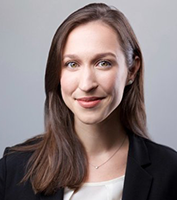
Molly Kelly Goss
| Clincal Fellow | Gastroenterology | Elizabeth Crouch Lab |
Research Topic: Vascular Stem Cells and Aberrant Angiogenesis in Intestinal Arteriovenous Malformations
I am a gastroenterology clinical fellow and post-doctoral researcher in Dr. Elizabeth Crouch's lab. My work meets at the intersection of vascular biology and gastroenterology to study the underpinning mechanisms of intestinal arteriovenous malformations (a lesion which presently has no durable treatment or cure). Leveraging single cell, spatial transcriptomic, and organoid techniques, we are pursuing deep evaluation of these lesions. This builds upon my prior doctoral studies with Dr. Shayn Peirce-Cottler at the University of Virginia, where I investigated endothelial and perivascular cell identity and plasticity to better understand the mechanisms of angiogenesis. Outside of lab, I enjoy attempting to make my favorite restaurant dishes at home, hiking with my family, and watching stand-up comedy.

Zhenmeiyu Li
| Postdoctoral Scholar | Department of Neurological Surgery | Arturo Alvarez-Buylla Lab |
Research Topic: The Mechanism of Cell Amplification in the Human CGE and Its Role in Ganglioglioma Susceptibility
I am a postdoctoral scholar in the Alvarez-Buylla Lab. My research focuses on the cellular and molecular mechanisms of human forebrain development, with particular attention to progenitor dynamics in the caudal ganglionic eminence (CGE). My study combines single-cell and spatial multi-omics approaches with in vivo mouse models to explore how progenitor proliferation and differentiation give rise to neuronal diversity, and how dysregulation of these processes contributes to neurodevelopmental diseases such as ganglioglioma.
Alex Murphy
| Clinical Fellow | Department of Surgery |Jason Pomerantz Lab |
Research Topic: Lipid Nanoparticles as Gene Therapy Vectors for Prenatal Treatment of Apert Syndrome
I am a UCSF plastic surgery resident who is currently participating in dedicated research time as part of the residency program's research track. Previously, I completed undergrad at the University of Pennsylvania, where I also conducted two years of post-baccalaureate translational research on primate models for HIV. I then attended Columbia University for medical school where I developed an interest in congenital bone disorders like Apert Syndrome. I am now excited to have the opportunity to help develop treatments for these disorders as a research resident! My hobbies include watching sports, skiing, golf, biking, and running with my fiancé and our dog Louis.
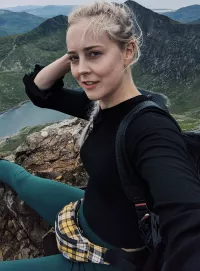
Sally Salomonsson
| Postdoctoral Fellow | UCSF Weill Institute for Neurosciences | Claire Clelland Lab |
Research Topic: Therapeutic gene editing of APOE4 for Alzheimer’s disease
I am a postdoctoral fellow in Claire Clelland’s lab, where we broadly focus on developing gene therapies for neurodegenerative diseases. I am originally from Sweden, though I lived in the UK (Scotland and England) for many years. I carried out my PhD work in Adrian Isaacs’ lab at UCL, with a scholarship from the UK Medical Research Council, investigating C9orf72-associated ALS/FTD mainly in patient-derived iPSC-motor neurons. Since completing my PhD, I have worked as a postdoc in the Clelland lab and chosen to work on therapies for Alzheimer’s disease linked to the APOE4 gene variant.
I was attracted to UCSF because of the closely connected and collaborative scientific and clinical communities, since I aspire to conduct neuroscience research with high clinical impact, and to work more closely with families affected by neurodegenerative diseases. Outside of work, I enjoy travelling, hiking and exploring, home microbiology (e.g. making kombucha) and creating and experiencing art. Check out my neuron art here: https://innercinema.co.uk/
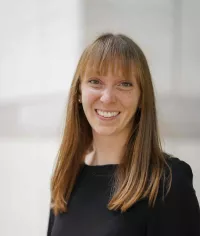
Marilyn Steyert
| Graduate Student | Department of Neurological Surgery | Tomasz Nowakoski Lab |
Research Topic: Unraveling shared molecular programming in truncated radial glia and supratentorial ependymoma
I’m a BMS graduate student in the Nowakowski lab and I’m interested in exploring how the human cortex is formed during development. Specifically, I am dissecting the roles of distinct populations of neural progenitors in healthy and altered states using lineage tracing. With some of these alterations, my goal is to create scalable models for pediatric brain tumors.
Before I joined UCSF, I received my BS in Biology with minors in Neuroscience and Music from St. Mary’s College of Maryland. Then, I was at University of Maryland Baltimore for a few years developing novel genome engineering tools to study cortical circuitry wiring, which was where I first fell in love with studying brain development. I spend most of my free time rock climbing— ideally outside somewhere beautiful.

Urvashi Thopte
| Graduate Student | Department of Neurological Surgery | Cathryn Cadwell Lab |
Research Topic: Elucidating the genomic mechanisms of FGF8 and retinoic acid (RA) signaling and interaction in human cortical areal specification
I am a Tetrad graduate student in Dr. Cathryn Cadwell’s Lab, and I am interested in the cellular and molecular mechanisms that drive human cortical development and their dysregulation in neurodevelopmental disorders. I am originally from India, and I graduated with an M.A. in Biotechnology from Columbia University in New York. Following this, I worked as a research technician at the Seaver Autism Center at Mount Sinai, developing high-throughput functional genomic technologies to identify convergent mechanisms involved in autism spectrum disorders (ASD). My current research focuses on retinoic acid (RA) signaling-driven gene regulation and its interplay with FGF8 signaling in human prefrontal cortex development and specification. Outside of lab, I enjoy reading, yoga, pilates, and hanging out with my dog, Chuck.

Atesh Worthington
| Postdoctoral Fellow | Department of Surgery | Tippi Mackenzie Lab |
Research Topic: Developing an in vivo hematopoietic stem cell genome editing strategy to treat a-thalassemia major
I’m a postdoctoral scholar in Tippi MacKenzie’s lab, where I study how alpha-globin is regulated. I am using lipid nanoparticle approaches for editing hematopoietic stem cells (HSCs) to develop in vivo therapies for alpha thalassemia major. I earned my PhD with Camilla Forsberg at UC Santa Cruz, focusing on how developmental programs shape HSC self-renewal and lineage potential, with particular interest in tissue resident immune cell development from HSCs. Alongside my research, I’m passionate about mentoring and improving equity in science, and I’ve been actively involved in programs and committees at UCSC and UCSF that support more inclusive training environments. Outside of science, I love to cook and host family and friends and listen to live music!

Yuwei Zhang
| Postdoctoral Fellow | Department of Cell and Tissue Biology | Julie Sneddon Lab |
Research Topic: Defining the Human Pancreatic Vascular Niche to Engineer Biomimetic Stem Cell-derived Islets for Type 1 Diabetes Therapy
I am a stem cell biologist with extensive training in regenerative medicine and a research focus on developing curative therapies for diabetes. My work has centered on understanding and overcoming the key challenges in beta cell replacement, from modeling genetic forms of diabetes to enhancing the survival and function of transplanted islets. As a Postdoctoral Scholar in Dr. Sneddon’s laboratory at UCSF, I am passionate about engineering the pancreatic islet vascular niche to improve the maturation of stem cell-derived beta cells, a project that directly addresses a critical bottleneck in the field. Throughout my PhD training in Beihang Univerisity and Columbia University, I used patient-derived induced pluripotent stem cells (iPSCs) and CRISPR/Cas9 gene editing techniques to elucidate the pathogenesis of beta cell failure in monogenic diabetes.
Outside the lab, I enjoy painting, hiking, tennis, rock climbing, and exploring new food spots.

Anastasia Zhurikhina
| Postdoctoral Fellow | Department of Biochemistry and Biophysics | Hanna Martens Lab |
Research Topic: Thymic Rejuvination
Hi, I’m Anastasia and I am a postdoctoral fellow in the Martens Lab at UCSF. I completed my PhD studying how mechanical cues and gene regulation shape tissue health, which sparked my interest in aging biology and the role of stromal cells in maintaining organ function. These experiences led me to the thymus, an organ that steadily declines with age and plays a central role in immune resilience.
In the Martens Lab, I study how fibroblasts support healthy thymic structure and how their dysfunction contributes to age related immune decline. I use single cell and spatial genomics along with genetic and viral tools to understand how fibroblast programs change over time. My long term goal is to develop targeted interventions that strengthen the aging immune system by restoring the stromal microenvironment.
Outside of lab, I enjoy exploring new coffee shops with my husband and our dog, and practicing flamenco. Ole!